
Uncategorized
Drainage System Inspection
The Problem You Cannot See Is Often the Most Expensive
A drain works, therefore the drainage system must be fine.
This is one of the easiest assumptions to make in plumbing.
Water disappears from the basin. The toilet flushes. The shower drains. There is no visible leak. From the outside, everything appears to be working.
But a drainage system can still transport wastewater while already developing a serious problem.
A pipe may be partially restricted by deposits. A joint may have moved. A buried pipe may have developed a crack. Roots may already be entering an underground drain. A backwater protection device may be installed but no longer operate correctly. A ventilation problem may disturb trap seals even though the wastewater pipe itself is open.
The important question is therefore not only:
Does the water drain?
The professional question is:
What is happening inside the system while it drains?
That difference separates simple observation from technical diagnosis.
A Drainage System Is More Than a Pipe
A building drainage system is a network.
Wastewater must move from sanitary fixtures through branch pipes, stacks, collectors, underground drainage and eventually toward the sewer or another disposal system.
But wastewater is only part of the process.
Air must move as well.
When water travels through a pipe, it occupies volume and changes pressure conditions inside the drainage system. If air cannot enter or leave the system correctly, negative or positive pressure can develop.
That pressure can affect trap seals, create gurgling noises and, in unfavorable conditions, allow sewer gases to enter occupied spaces.
Gravity, pipe geometry, airflow, pipe condition and flow resistance therefore work together.
A drainage problem should never be understood only as:
Water + pipe = drainage.
It is a hydraulic and pneumatic system.
Why Drainage Problems Develop Slowly
Many drainage failures do not happen suddenly.
They develop.
A small layer of contamination forms inside the pipe. More material attaches to it. The effective cross-section becomes smaller. Flow behavior changes. Solids are transported less reliably. Additional deposits accumulate.
The technician eventually sees a blocked drain.
But the blockage may only be the final symptom of a process that has been developing for months or years.
The same principle applies to damaged underground pipes.
A minor displacement at a joint may initially have little effect. Over time, however, it can create a location where solids accumulate. If the joint allows root intrusion, the obstruction may continue to grow.
What begins as a small defect can eventually become a recurring service problem.
The visible failure is often the last part of the story.
The professional task is to understand the first part.
REMEMBER – IMPORTANT
A blocked drain is a symptom.
The technical question is why the blockage developed and whether the cause remains after the pipe has been cleaned.
Slow Drainage: Do Not Diagnose Too Quickly
A basin drains slowly.
The obvious conclusion is a blockage.
Often that is correct.
But not always.
The restriction may be located directly at the trap. It may be farther downstream. Several fixtures may share a partially obstructed branch. The pipe may have insufficient or irregular fall. The internal diameter may be reduced by deposits. A damaged pipe section may interrupt normal flow.
Even ventilation can influence how a drainage system behaves.
This is why diagnosis should begin with the pattern of symptoms.
If only one washbasin is affected, start locally.
If the washbasin, shower and toilet in the same area are affected, look for a common section.
If fixtures on several levels behave abnormally, the problem may be located in a stack, collector or another shared part of the drainage network.
The number and location of affected fixtures provide information before a tool even enters the pipe.
Gurgling Is Information
A gurgling drain is often treated as an annoyance.
For a technician, it is information.
The sound tells you that water and air are interacting somewhere in the system.
Imagine a large volume of wastewater moving through a pipe. Behind that moving water, pressure can fall. The system needs air to equalize the pressure.
If sufficient air cannot enter through the intended ventilation path, the system may try to obtain it somewhere else.
A sanitary trap can become that path.
The result may be movement of the water seal and the familiar gurgling sound.
The technician should therefore avoid assuming that every unusual drainage noise is caused by dirt.
The sound may be the symptom.
Pressure behavior may be the mechanism.
Ventilation or a restriction may be the cause.
That is technical diagnosis:
SYMPTOM → MECHANISM → CAUSE
Odor Does Not Automatically Mean a Blockage
Sewer odor inside a building should be investigated systematically.
Possible causes include a dry trap, disturbed water seal, leaking connection, damaged pipe, unused floor drain, defective component or ventilation problem.
The key principle is simple:
A drainage system should transport wastewater while preventing sewer gases from entering occupied areas.
The trap creates a water barrier between the room and the drainage network.
If that barrier disappears, becomes disturbed or is bypassed through a leak, odor can enter the building.
Replacing components without understanding the gas path may therefore solve nothing.
Ask:
Where could the air be coming from?
Which barrier should stop it?
Is that barrier present?
Can pressure fluctuations disturb it?
Is there a concealed leakage path?
The nose detects the symptom.
The technician must find the path.
Underground Drainage Changes the Diagnostic Game
Accessible drainage pipes can be visually inspected.
Buried pipes cannot.
This is where assumptions become dangerous.
An underground drain may contain deposits, displaced joints, deformation, foreign objects, root intrusion or structural damage while appearing completely normal from above ground.
Repeated cleaning without identifying the underlying condition can become an expensive cycle:
Blockage → cleaning → temporary improvement → blockage again
When the same problem returns, the diagnostic strategy should change.
The question is no longer:
How do we clear the pipe?
It becomes:
Why does this pipe keep blocking?
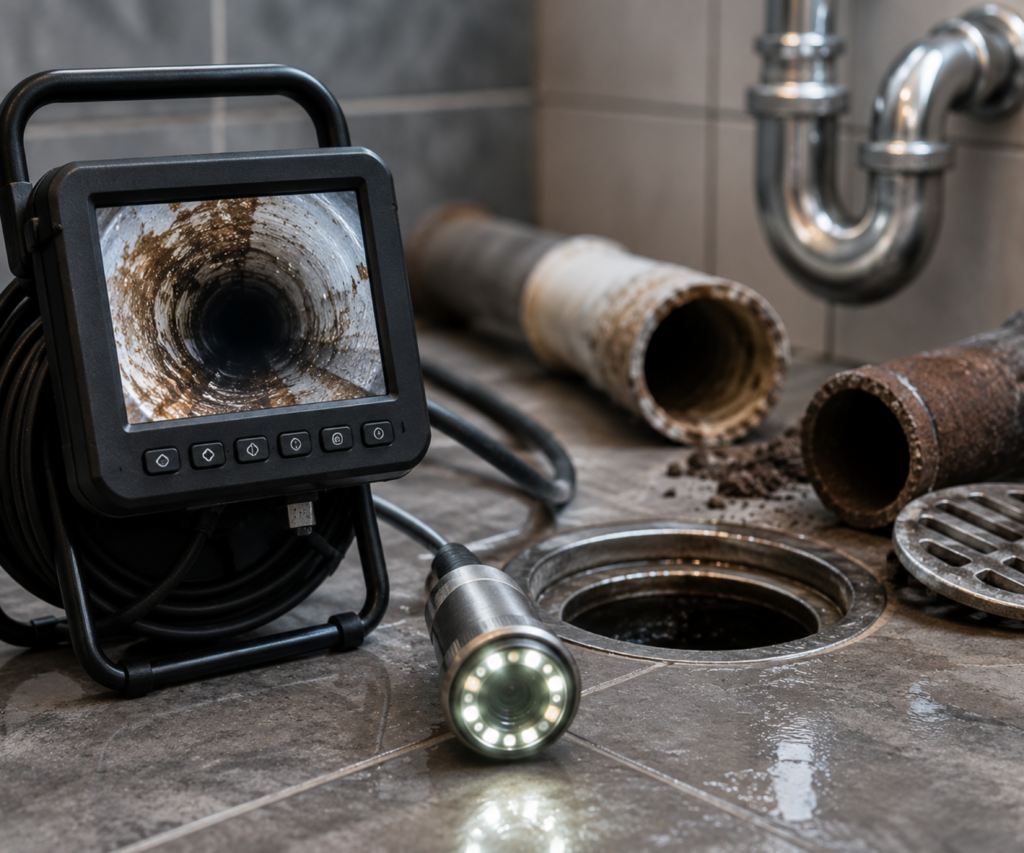
Camera inspection can then become a valuable diagnostic tool.
The purpose is not simply to record a video.
The purpose is to connect the visible internal condition of the pipe with the symptoms observed in the building.
USE IT IN PRACTICE
You arrive at a building where the basement drain has blocked for the third time.
Do not begin by assuming that the previous cleaning was inadequate.
First establish the history.
Which fixtures are affected?
How often has the problem occurred?
Does it happen after heavy use or rainfall?
Was the pipe previously cleaned?
Was a camera inspection performed?
Is backflow from the public sewer possible?
Then inspect the accessible system.
After cleaning, verify flow and consider inspecting the affected pipe section internally if the recurring fault cannot otherwise be explained.
A recurring blockage is telling you something.
Listen to the system before replacing parts or repeatedly performing the same service.
Camera Inspection: Seeing Is Not the Same as Understanding
A camera can show the inside of a pipe, but interpretation remains a professional task.
A deposit is not automatically the root cause.
A joint irregularity is not automatically responsible for the blockage.
A pipe may contain several visible imperfections while only one actually affects operation.
The technician must connect:
location + pipe condition + flow direction + symptom + history
This is why documentation matters.
If a defect is found, its location should be identified as accurately as the inspection method allows. Images or video should be retained where appropriate, and the relationship between the defect and the reported problem should be explained.
Good diagnostics do not merely produce pictures.
They produce decisions.
Backwater Protection: Installed Does Not Mean Protected
A backwater valve or wastewater lifting system may remain unnoticed for years.
Then the sewer backs up.
That is the worst moment to discover that the protection device no longer works.
Moving components can become contaminated. Pumps can fail. Sensors can malfunction. Valves can become obstructed. Maintenance may have been neglected.
Protection therefore depends on more than installation.
It depends on continued functionality.
Where backwater protection is required, the system design, installation, accessibility, inspection and maintenance must follow the applicable requirements and manufacturer instructions for the specific installation.
Never assume that a device provides protection simply because it is physically present.
Rainwater Is Part of Drainage Thinking
Drainage inspection should not automatically stop at wastewater.
Roof drains, balcony drains, gutters, downpipes and underground rainwater systems can also create serious building damage when they lose capacity.
A partially blocked roof drain may appear harmless during light rain.
During intense rainfall, the situation changes.
The incoming water quantity increases while the available drainage capacity remains restricted.
Water accumulates.
The system has not suddenly become defective.
The defect was already there.
The operating condition simply exposed it.
This is an important engineering principle:
A system can appear functional under low load and fail under high load.
The same principle applies to many technical systems — pumps, valves, heating circuits and drainage networks.
TECHNICAL CONSEQUENCES
Ignoring early drainage symptoms can lead to more than inconvenience.
Depending on the system and defect, consequences may include recurring blockages, wastewater leakage, odor problems, moisture damage, contamination, damage to building materials, failure of pumps or protection devices and costly emergency work.
The financial difference between inspection and failure can be significant.
A planned inspection can be performed methodically.
An emergency occurs when the system chooses the time.
And drainage systems rarely choose a convenient one.
BONUS TRICK FOR TRADESPEOPLE
When several drainage fixtures show problems, do not start by looking at each fixture separately.
Map the affected fixtures mentally onto the drainage network.
Ask:
Where do their drainage paths first meet?
That common pipe section is often a better starting point for diagnosis than the individual fixture where the customer first noticed the symptom.
This simple approach can reduce unnecessary dismantling and help separate a local fault from a system fault.
Cleaning Is Not Diagnosis
Drain cleaning restores flow.
Diagnosis explains why flow was lost.
Sometimes cleaning is the complete solution because the obstruction was an isolated event.
Sometimes it is only the first step.
If deposits repeatedly form at the same location, if roots return, if a pipe section is damaged or if geometry causes recurring accumulation, restoring flow does not remove the underlying cause.
A professional should therefore distinguish between:
RESTORING FUNCTION
and
REMOVING THE CAUSE
Both may be necessary.
They are not the same task.
Inspection Should End With a Decision
A professional drainage check should produce usable information.
What was inspected?
What was found?
Which finding is relevant?
Does immediate repair appear necessary?
Should the condition be monitored?
Is further inspection required?
Should cleaning, repair, rehabilitation or replacement be considered?
Does a manufacturer specification, local regulation, technical standard or additional measurement need to be verified before a final decision is made?
Not every irregularity requires immediate replacement.
But every important irregularity should be understood.
REMEMBER – IMPORTANT
Do not repair the symptom until you understand the system.
The best drainage diagnosis connects what the customer notices with what is physically happening inside the pipe network.
MINI TEST FOR THE TRADESPERSON
1. A drain is cleaned successfully but blocks again three months later. What should change in your approach?
Do not simply repeat the same procedure. Investigate why contamination repeatedly develops and whether the pipe condition, geometry, usage or another system factor is responsible.
2. A customer reports gurgling from a washbasin when another fixture discharges. What would you investigate?
Consider not only a local blockage but also pressure behavior, shared drainage sections and ventilation of the drainage system.
3. A backwater protection device is installed. Can you assume the building is protected?
No. The suitability of the system and the operational condition of the protection device must be verified according to the specific installation and applicable requirements.
A professional drainage inspection begins with wastewater, but it teaches a much broader lesson.
Technical systems rarely fail at the moment the underlying problem begins.
The problem develops first.
The symptom comes later.
Learning to recognize that difference is one of the foundations of professional troubleshooting — and it becomes even more important when the next system contains moving components, pressure, sensors and pumps.
