
Uncategorized
Pipe Connection Methods
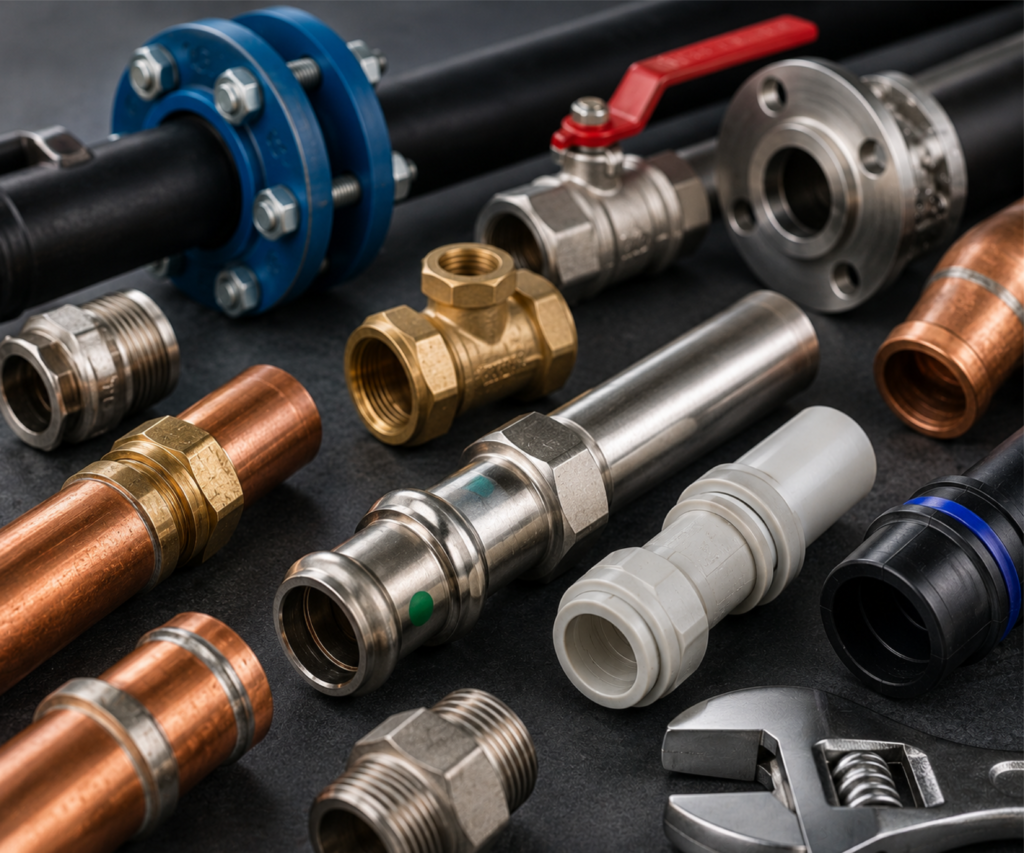
Pipe Connection Methods: A Practical Guide for Plumbing and HVAC Systems
Pipe connections are one of the most critical parts of any plumbing, heating, cooling, or mechanical installation. Even when the correct pipe material and diameter have been selected, an unsuitable or poorly executed joint can become the weakest point of the entire system.
Modern installers can choose from several connection methods, including pressing, threading, soldering, welding, compression fittings, push-fit systems, and bonding.
The correct method depends on the pipe material, operating conditions, accessibility, installation environment, and the requirements of the system manufacturer.
Two Main Types of Pipe Connections
From a practical installation perspective, pipe connections can generally be divided into two categories:
Detachable connections can normally be opened using appropriate tools without cutting or destroying the main pipework.
Permanent connections are intended to remain assembled during normal service and generally require cutting, destruction, or replacement of part of the connection to separate the components.
This distinction becomes particularly important when deciding whether a connection can be installed inside a wall, floor, shaft, or another location with limited accessibility.
Threaded Connections
Threaded connections are among the traditional methods used in plumbing and heating installations.
They are commonly found on steel pipework, valves, pumps, filters, gauges, boilers, hydraulic components, and equipment connections.
A threaded connection typically consists of male and female threads combined with an appropriate sealing system.
Typical applications
- steel heating pipework,
- valves and fittings,
- circulation pumps,
- pressure gauges,
- filters and separators,
- equipment connections.
Advantages
Threaded connections are relatively simple to assemble and can usually be dismantled for maintenance or replacement.
Limitations
The connection depends heavily on correct thread preparation, sealing material, alignment, and tightening.
Threaded joints should also remain accessible where future maintenance or leakage inspection may be necessary.
Flanged Connections
Flanges are widely used for larger pipe dimensions and equipment that may need to be removed during its service life.
Typical examples include pumps, heat exchangers, large valves, boilers, chillers, and mechanical plant installations.
Two flange faces are connected using bolts, with a suitable gasket positioned between them.
Advantages
Flanged connections provide excellent accessibility for maintenance and allow large components to be removed without cutting the pipework.
Important installation factors
Correct alignment is essential.
The flange should not be forced into position using the bolts to compensate for poorly aligned pipework. Gasket selection, bolt tightening, operating pressure, temperature, and medium must also be considered.
Compression Fittings
Compression fittings create a mechanical seal by compressing a ring or sealing element around the pipe.
They are frequently used with copper, stainless steel, plastic, and other pipe systems depending on the fitting design.
One major advantage is that installation can often be completed without heat or electrical pressing equipment.
However, the pipe must be correctly prepared and inserted according to the manufacturer’s specifications.
Compression connections may require accessibility depending on the system design and applicable installation requirements.
Press Connections
Press fitting technology has become one of the most widely used connection methods in modern plumbing and HVAC installations.
Press systems are available for materials including:
- copper,
- stainless steel,
- carbon steel,
- multilayer composite pipe,
- selected plastic piping systems.
The prepared pipe is inserted into the fitting and permanently compressed using a compatible pressing tool and press jaw.
Why installers use press fittings
Pressing is fast, repeatable, and requires no open flame.
This makes the method particularly attractive for renovation work, commercial buildings, plant rooms, and locations where hot-work procedures would otherwise be necessary.
However, successful pressing depends on correct installation.
The pipe must be cut correctly, deburred where required, inserted to the specified depth, and pressed with the correct tool and profile.
A press fitting is only as reliable as the installation procedure used to make it.
Soldered Connections
Soldering remains an established connection method, particularly for copper pipework.
The joint is created by heating the prepared connection and allowing solder to form the bond between the components.
Depending on the application, different soldering processes and materials may be required.
Good preparation is essential. Contaminated surfaces, residual water inside the pipe, incorrect heating, or inappropriate materials can compromise the connection.
Because heat is involved, installers must also consider fire protection and the surrounding building materials.
Welded Connections
Welding creates a permanent connection by joining the pipe materials together.
It is commonly used for steel pipework and industrial or larger mechanical installations.
Different welding techniques may be used depending on pipe material, dimensions, application, and installation conditions.
Typical applications
- heating plant rooms,
- industrial pipework,
- large steel distribution systems,
- energy installations,
- mechanical equipment connections.
Welding can provide highly durable connections, but it requires suitable equipment, qualified personnel, correct preparation, and controlled working conditions.
Push-Fit Connections
Push-fit systems allow pipes to be inserted directly into specially designed fittings.
Internal sealing and retention components create the connection.
Their main advantage is installation speed.
Depending on the manufacturer and system, they can be used for metallic, plastic, or multilayer piping.
However, not every push-fit connection should automatically be considered suitable for concealed installation.
The installer must check the manufacturer’s approval, pipe compatibility, operating conditions, and installation requirements.
Sliding Sleeve Connections
Sliding sleeve systems are frequently used with plastic and multilayer piping.
The pipe end is prepared and connected to the fitting using a sleeve that mechanically secures the pipe around the fitting body.
These systems can provide strong permanent connections and are commonly used in potable water and heating installations.
Correct tools and manufacturer-specific installation procedures are essential.
Bonded Connections
Bonding or solvent-weld connections are primarily associated with plastic piping systems.
Depending on the material, the connection may use a chemical solvent or adhesive system to create a permanent joint between the pipe and fitting.
Typical applications can include drainage, process piping, technical water systems, and other plastic pipe installations.
Surface preparation, insertion depth, curing time, temperature, and material compatibility must be carefully observed.
Which Pipe Connection Is Best?
There is no single connection method that is best for every installation.
The correct choice depends on the complete operating environment.
| Connection | Typical Application | Detachable | Heat Required | Installation Speed |
|---|---|---|---|---|
| Threaded | Steel pipe, valves, equipment | Yes | No | Medium |
| Flanged | Pumps, valves, large pipes | Yes | No | Medium |
| Compression | Copper/plastic connections | Usually | No | Fast |
| Press | Plumbing & heating systems | No | No | Very fast |
| Soldered | Copper pipe | No | Yes | Medium |
| Welded | Steel/industrial systems | No | Yes | Slow |
| Push-fit | Plumbing & heating | System-dependent | No | Very fast |
| Sliding sleeve | Plastic/composite pipe | No | No | Fast |
| Bonded | Plastic pipe systems | No | No* | Fast |
*Depending on the bonding system and material.
Accessibility Matters
One of the most important considerations is whether the connection may require inspection, tightening, maintenance, or replacement later.
A connection hidden behind a tiled wall, inside a floor construction, or beneath insulation is fundamentally different from a connection installed in an accessible plant room.
Where a connection cannot be considered permanently secure according to the applicable system requirements, accessibility should be maintained.
This is particularly important for mechanical joints that may be affected by thermal expansion, vibration, movement, or repeated maintenance.
Manufacturer Compatibility Is Critical
Modern pipe systems should be considered complete installation systems rather than collections of interchangeable components.
Pipe, fitting, sealing element, press profile, installation tool, temperature rating, pressure rating, and application approval must be compatible.
A fitting that physically fits onto a pipe is not automatically approved for that pipe.
The same principle applies to pressing tools.
A press jaw may appear compatible with several fittings while the manufacturer requires a specific press contour or tool combination.
Always verify the approved system combination before installation.
Common Installation Mistakes
Many failures are not caused by the connection technology itself but by incorrect installation.
Typical problems include insufficient pipe insertion, incorrect press jaws, damaged sealing rings, poorly prepared pipe surfaces, incorrect tightening, contamination, misalignment, unsuitable sealing materials, and mixing components from incompatible systems.
For professional installations, connection points should therefore be included in the final inspection and pressure or leak testing procedure required for the system.
The Installer’s Rule
Choosing a pipe connection should never be based only on which method is fastest.
Consider:
Pipe material → medium → pressure → temperature → accessibility → installation environment → manufacturer approval → testing requirements
Pressing may be ideal for one project, welding for another, and detachable flanged or threaded connections may be preferable around serviceable equipment.
The best connection is the one that remains safe, tight, serviceable, and appropriate for the operating conditions throughout the expected life of the installation.
Conclusion
Pipe connection technology has evolved significantly.
Traditional threaded, soldered, and welded joints remain important, while press, push-fit, compression, and sliding sleeve systems have made installation faster and more flexible.
For professional plumbers and HVAC technicians, however, the fundamental principle remains unchanged:
The quality of a piping system depends not only on the pipe itself, but on every connection between its components.
Selecting the correct joining method, following the manufacturer’s installation requirements, using compatible tools and materials, and properly testing the finished system are essential for reliable plumbing and HVAC installations.
